Who’s actually watching your CTV ad? India’s 200 million-plus-viewer measurement puzzle
India’s connected TV audience may have crossed 200 million, but shared screens, common logins and hybrid DTH-CTV households complicate a basic question for advertisers: who exactly saw the ad?
 by
by
Published: Oct 5, 2026 9:07 AM | 8 min read
 Follow Us

- India’s connected television (CTV) audience is estimated to exceed 200 million, but measuring individual viewership remains challenging due to shared screen usage among family members in multigenerational households.
- Advertisers can determine device-level exposure but struggle to identify which specific individuals viewed an ad, often relying on household data and co-viewing assumptions to estimate reach.
- Measurement providers like Nielsen combine device data with demographic information and statistical modeling to estimate person-level reach, but the process remains complex, particularly when deduplicating audiences across linear TV, CTV, and mobile.
- Marketers are adapting to these measurement challenges by treating audience data as indicators of exposure rather than precise counts, with some emphasizing the value of co-viewing in family decision-making contexts.
India’s connected television audience may now run into more than 200 million people, but an advertiser trying to understand exactly which of those people saw a particular commercial runs into a rather more basic problem: a television is not a person.
In Indian homes especially, the same screen may be used by parents, children, grandparents and other family members, sometimes simultaneously and often through the same streaming account. The person logged into the television may not be the one watching it. And the same device may move between DTH, streaming apps, YouTube and other connected services over the course of a day.
For advertisers, that creates a widening distinction between knowing that an ad reached a device, knowing that it reached a household, and knowing which individual actually saw it.
Also Read: As CTV scales in India, can ad loads rise without breaking the viewing experience?
As India resets TV ratings, digital’s measurement black boxes loom larger
Beyond Reach: Can AI-generated ads turn attention into action?
Tech Talk
“The simplest way to think about CTV measurement is that an impression can tell you the house, but not necessarily who had the remote,” said Gulrez Alam, Chief Revenue Officer - India & Emerging Markets at Affle.
Alam said device-level signals can establish where an impression was delivered and support targeting, retargeting and frequency management, while household IDs can connect exposure on the television with activity on other devices within the home.
The difficult step is moving from household exposure to individual reach.
Authenticated identity can provide a stronger signal, he said, but CTV remains a shared-screen environment in which several people may be watching the same television and the person logged in may not be the only viewer. Where individual identity cannot be established directly, household size and co-viewing assumptions may instead be used to estimate individual reach.
That distinction becomes particularly relevant in India’s multigenerational households.
Samsung Ads India’s GM and Head of Revenue Nishit Kanchan said device-level viewing data does not necessarily correspond neatly with the individuals in front of the screen, partly because users do not routinely change accounts or profiles depending on who has started watching.
What smart-TV platforms can observe more directly are patterns of content consumption within the household: children’s programming during school holidays, sports around major tournaments, news during significant events or devotional and family-oriented programming during festive periods.
“The signals we observe represent a combination of content preferences and viewing behaviours within that household rather than the identity of an individual viewer,” Kanchan said.
That does not necessarily mean CTV audiences are being overstated.
In fact, The Trade Desk argues that the opposite can sometimes be true.
“The industry has spent years measuring devices. The next phase of CTV measurement is understanding people,” said Rahul Kapoor, VP - Partnerships at The Trade Desk.
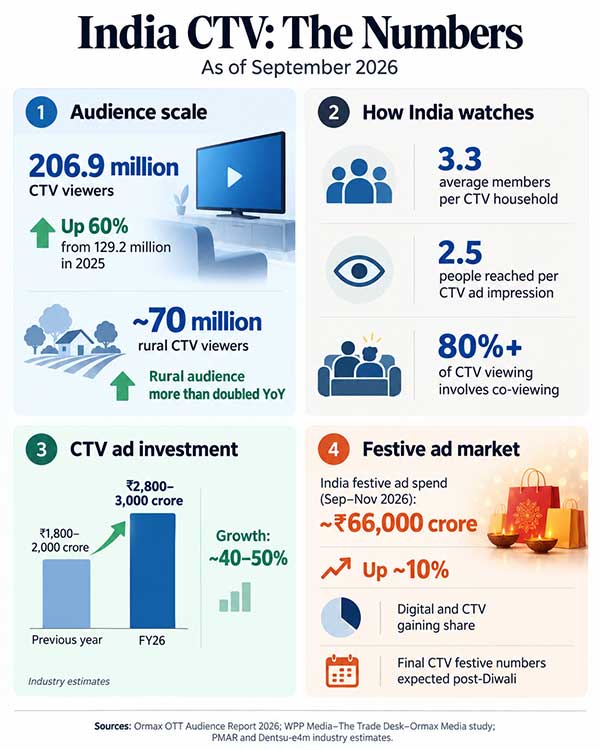
Research cited by the company estimates that a single CTV advertising impression reaches an average of 2.5 household members. That means a device-level impression may understate the number of people actually exposed to an ad when families or groups watch together.
The result is a peculiar measurement paradox. The shared nature of television can make individual-level identification less precise while simultaneously making each delivered impression potentially more valuable.
Brand speak
For marketers, that leaves the question of how much precision they actually need.
Amit Mathur, President - Sales and Marketing at Finolex Cables, said platform-level audience data should be treated as an indicator of exposure rather than a perfect measure of precisely who saw an advertisement.
Finolex therefore looks at multiple signals including reach, frequency, completion rates, engagement and subsequent consumer action rather than relying on a single reported audience number. The advertiser also examines whether the profile being reached aligns with the intended target audience and whether additional frequency is building recall or simply creating repeated exposure within the same household.
For some categories, meanwhile, household exposure may be a feature rather than a flaw.
Rima Kirtikar, Chief Marketing Officer at Shapoorji Pallonji Real Estate, pointed out that buying a home is often a collective family decision. In that context, several people seeing the same ad together may itself be valuable.
The company therefore evaluates CTV using a combination of reach, frequency, completion rates and audience profile, rather than treating every impression as equivalent to one individual viewer.
“Co-viewing should therefore be factored into how CTV campaign results are interpreted, particularly when assessing unique audience reach,” Kirtikar said.
For other advertisers, however, the remaining uncertainty can affect where money is spent.
Nisha Khatri, Head of Marketing, Libas, describes the fashion brand's media strategy as traditionally performance-led, said areas including individual-level viewership, shared-screen behaviour and incremental reach across devices are still evolving from a measurement standpoint.
As a result, “Libas currently allocates a larger proportion of its media budget to digital channels where the link between investment and measurable business outcomes is clearer, while continuing to evaluate CTV as its measurement ecosystem matures,” says Khatri.
The second part of the problem begins once advertisers try to understand whether CTV is reaching people they were not already reaching elsewhere.
The same Indian television can be used for both connected viewing and traditional DTH or cable. A household may therefore encounter the same brand through linear television in one part of the day and CTV in another, while the same individuals are also exposed through mobile devices.
Smart-TV manufacturers can increasingly see parts of that journey.
Samsung Ads uses Automatic Content Recognition, or ACR, to identify content being played on Samsung televisions, including both linear and connected viewing. The company says this allows it to identify televisions exposed to a linear television campaign and subsequently use CTV inventory to reach households that were not exposed.
In one campaign for a large consumer packaged goods advertiser in India, Samsung Ads said its CTV campaign delivered 47% incremental reach over linear television.
But there is an important limitation.
TL;DR
ACR identifies what is playing on the television, not who is sitting in front of it. Samsung says its ACR data is anonymous and device-level, with no personally identifiable information attached to the viewing data.
That leaves advertisers with an increasingly sophisticated view of the household while person-level measurement remains harder.
The challenge becomes more pronounced when advertisers try to deduplicate audiences across linear television, CTV and mobile.
Alam said the three still operate across different measurement systems in India, making reliable deduplication across all of them difficult at a national level. Linear television continues to rely more heavily on panels, extrapolation and modelling, while CTV and mobile can use household and device-level signals to connect exposure across screens and measure downstream behaviour.
Kapoor made a similar distinction. Across CTV and mobile, household-level identity signals can increasingly help advertisers deduplicate audiences and manage frequency, he said. But establishing total reach across streaming and linear TV remains more complex because linear television measurement itself continues to depend significantly on panel-based data and modelling.
For marketers, the commercial question is therefore no longer simply whether an advertisement was served to a connected television.
It is whether that impression represented one person or several; whether those viewers had already been reached through linear television or mobile; and whether the additional exposure ultimately changed anything.
CTV can increasingly tell advertisers which screen received an ad, what was being watched and, in many cases, how that household behaved across connected devices.
Knowing exactly who in that household saw it remains the harder part.
Read more news about Digital Media, Internet Advertising, Marketing News, Television Media, Radio Media
For more updates, be socially connected with us onInstagram, LinkedIn, Twitter, Facebook, YouTube & Google News
